For years, my relationship with AI was pretty straightforward. I'd use it to brainstorm ideas, summarize information, explore creative directions, or help move a project along a little faster. Useful? Absolutely. Transformational? Not particularly.
That changed when I joined Juniper Square.
One of the first challenges put in front of me wasn't a traditional creative challenge. It wasn't a rebrand, a campaign, or a new visual identity. It was a much bigger question:
How could I use AI to fundamentally change the way I work and how my team operates?
The goal wasn't simply to introduce another tool into our workflow. It was to build an integrated system that could help manage creative operations, empower employees to create on their own, improve brand consistency, and give our team more time to focus on the work that actually requires creative thinking.
What started as an experiment with Claude quickly became one of the most interesting operational projects I've worked on in my career.
First, fix the foundation
Before we could teach AI how to create things, we had to figure out what we actually wanted it to create.
Like many established companies, Juniper Square had accumulated years of visual identity decisions, agency work, legacy templates, and brand inconsistencies. There had been several attempts at refreshing the brand over the years, and pieces of those efforts had made their way into everyday materials. The result was a fragmented visual identity without a truly unified design system.
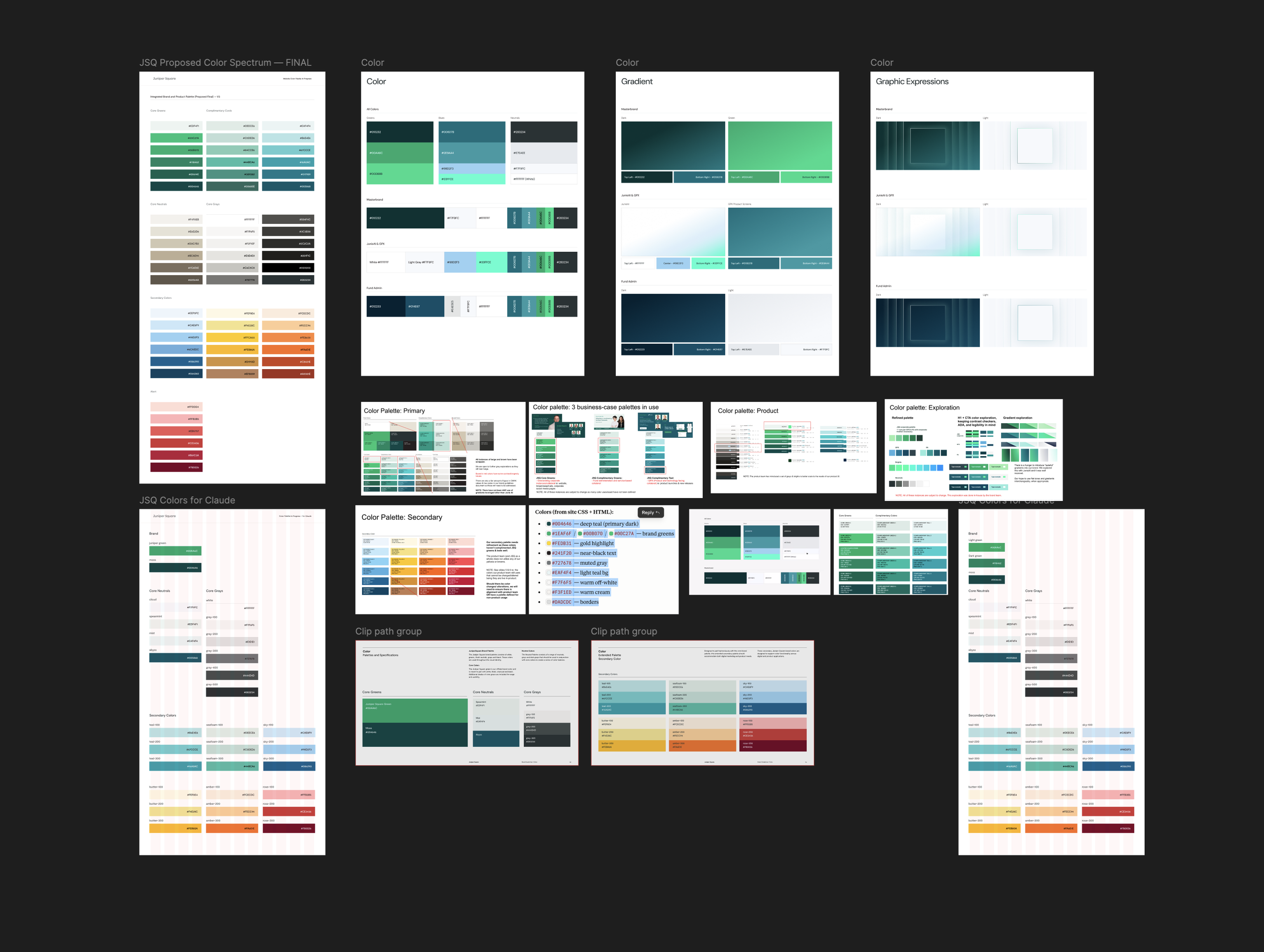
The color palette alone had more than 40 colors, many of which were inconsistently applied. Some of the templates circulating internally were five, ten, or even more years old.
I started by conducting a comprehensive audit of the visual identity.
Using Figma, I organized the materials into categories, collected examples, and created a consolidated view of how the brand was actually being used throughout the company. This gave me the opportunity to identify inconsistencies, eliminate unnecessary complexity, and establish a more cohesive foundation.
Rather than pursue another disruptive rebrand, I focused on simplifying what already existed.
We reduced the color palette from more than 40 colors to 12, clarified typography and usage standards, and rewrote the brand guidelines.
It wasn't about making the brand something entirely new. It was about making it easier to understand, easier to use, and easier to maintain.
That foundation would become incredibly important for everything that came next.
Teaching AI how to think about the brand
Here's something I learned pretty quickly: AI is only as good as the information, context, and instructions you give it.
You can't hand an AI platform a folder of outdated brand assets, give it a vague prompt, and expect it to consistently produce professional, on-brand work.
It needs structure. It needs context. And it needs rules.
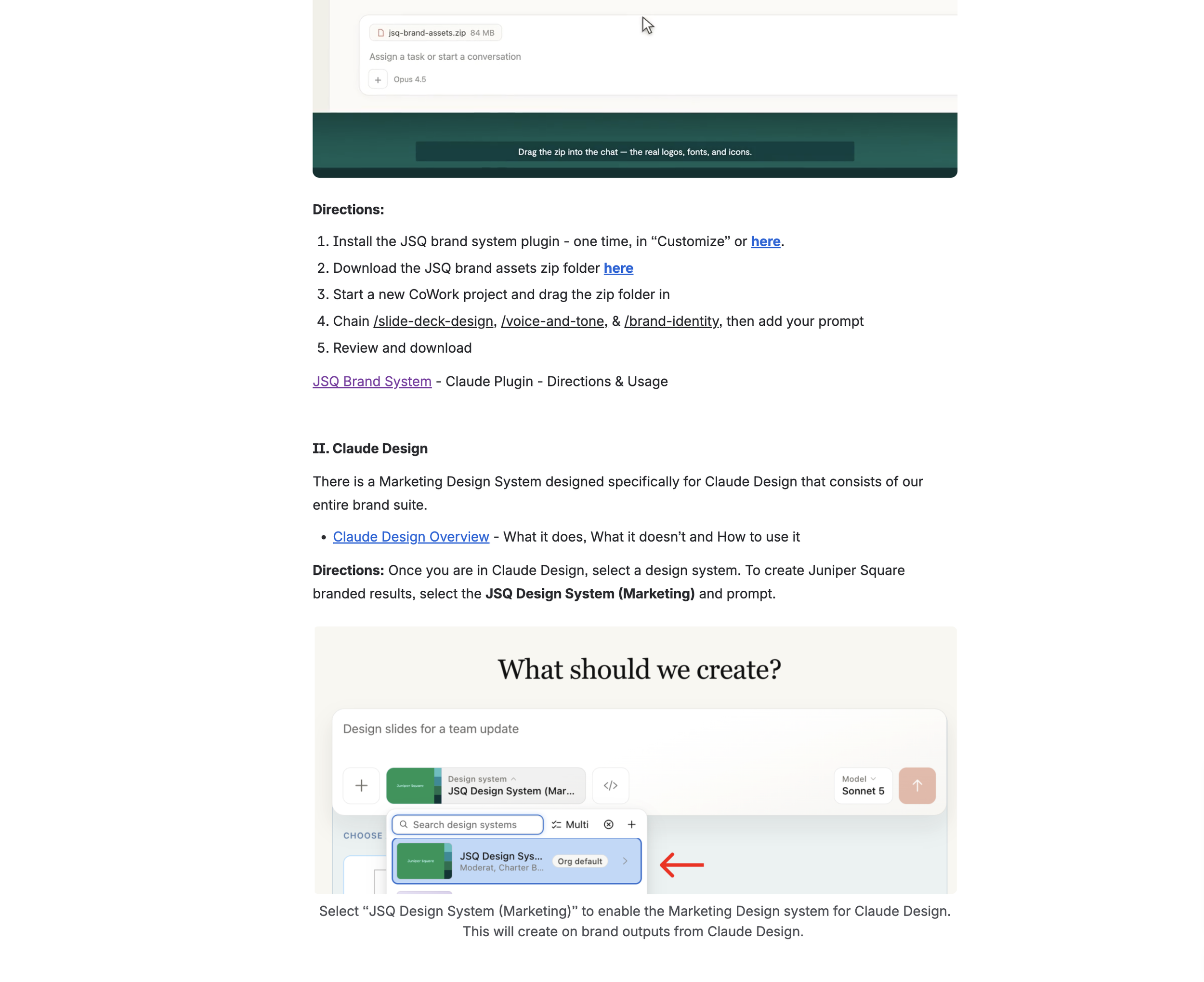
I took the updated brand guidelines and used them to train Claude on how Juniper Square should look and feel. This included everything from approved colors and typography to logo usage, layouts, and the practical application of the visual identity.
We also established guidance around when employees should use different Claude capabilities, including Claude CoWork, Claude Design, and Claude Code.
We created instructional videos and practical guidance to help employees understand not just how to use these tools, but when to use them and when not to.
This distinction matters.
The goal wasn't to let AI make foundational brand decisions. Those decisions still require human judgment, experience, and creative direction. The goal was to give AI enough context to handle repeatable production work without compromising the integrity of the brand.
Connecting the dots: Building an integrated system
This is where things got really interesting.
One of the biggest limitations we encountered early on was how AI accessed company information. Having years of documentation sitting in Google Drive didn't necessarily mean Claude could reliably find, interpret, and use that information.
As part of a broader company initiative, Juniper Square consolidated internal documentation into a centralized GitHub repository. This gave Claude a much more reliable source of company knowledge to reference.
Suddenly, the possibilities extended well beyond creative production.
We connected Claude to different platforms and sources of information, including:
GitHub: A centralized source of company documentation, customer information, case studies, and institutional knowledge.
Wistia: Through an MCP integration, Claude could access transcripts from years of stored video content, making previously difficult-to-search information discoverable.
Slack: Helping monitor incoming creative requests, surface conversations, and keep work from falling through the cracks.
Asana: Supporting task creation, request management, and recurring updates on upcoming creative work.
The interesting part wasn't any individual integration. It was how these systems started working together.
For example, a customer success manager preparing for an important customer meeting could ask Claude to find relevant case studies, identify similar customer challenges, and surface information from historical video transcripts.
Instead of spending time searching through folders, documents, and years of archived content, they could get relevant information in seconds.
The same principle applied to creative operations.
Incoming requests could be identified, surfaced, and translated into Asana tasks. Weekly updates could be generated from project information. Employees could get help finding existing materials or determining whether they could create something themselves rather than submitting another request to the creative team.
We were moving beyond AI as an individual productivity tool and toward AI as an interconnected operational layer.
Empowering people to create without sacrificing the brand
One of the most practical applications of the system was creative self-service.
Our creative team regularly received requests for PowerPoint presentations, one-pagers, internal sales materials, and other pieces of collateral. These requests were important, but they also consumed time that could otherwise be spent on larger initiatives.
We started with the most common requests: presentation templates and one-pagers.
By training Claude on our brand guidelines and establishing specific instructions for different types of deliverables, we created a workflow that allowed employees to generate usable, brand-aligned first drafts independently.
The idea wasn't to produce award-winning design.
It was to help someone get past the blank page, organize their information, and produce something professional enough for its intended purpose.
That distinction is important.
A quick internal presentation doesn't necessarily require the same level of creative refinement as an executive keynote, a major campaign, or a high-profile customer-facing experience.
AI gave employees a way to handle more routine needs independently while allowing the creative team to concentrate on work that required a higher level of craft and strategic thinking.
We also built a feedback and visibility process around these self-service assets.
When employees created materials using Claude Design or CoWork, they could opt to share their work with the creative team. Notifications were delivered through Slack or email, allowing us to review what was being produced and identify potential brand inconsistencies before materials circulated more widely.
This was an important part of the system.
Self-service without governance can quickly become another source of brand fragmentation. By building visibility and review into the workflow, we could give employees more creative independence without giving up responsibility for the brand.
The real impact: Giving creative teams their time back
The most meaningful result wasn't that we could generate a PowerPoint faster.
It was what that meant for the creative team.
After implementing the self-service workflow, we significantly reduced the need for our team to produce routine, one-off collateral and support internal asset creation in the same way we had before.
That allowed us to redirect more of our time toward higher-priority initiatives, including major marketing campaigns, product launches, and corporate website projects.
We weren't replacing designers, project managers, or copywriters. We were reducing the amount of repetitive production work competing for their attention.
And that's where I think the real opportunity lies.
Creative teams are often stretched thin. They're expected to support every department, respond to urgent requests, maintain brand consistency, and simultaneously deliver the kind of strategic work that moves a business forward.
The answer isn't necessarily to hire more people or work longer hours.
Sometimes it's to rethink the system those people are working within.
AI doesn't replace creative leadership. It makes it more important.
One of my biggest takeaways from this experience is that implementing AI successfully requires more creative leadership, not less.
Someone still needs to establish the standards. Someone needs to understand what good looks like. Someone needs to recognize when the output is wrong, when the brand is being compromised, and when a project requires a level of creative thinking that AI simply can't provide.
AI can generate a draft. It can organize information. It can identify patterns and automate repetitive tasks.
But it doesn't inherently understand the strategic intent behind a brand or the nuance behind a creative decision.
That responsibility still belongs to people.
In fact, I would argue that the more we empower employees to create independently, the more important it becomes to have strong creative direction and governance behind the scenes.
The technology is only one part of the equation. The systems, standards, training, and human oversight are what make it useful.
What's next?
I don't think what we built at Juniper Square is unique to one company or one creative department.
The same principles can be applied to marketing teams, sales organizations, customer success, and nearly every other department that relies on information, communication, and repeatable workflows.
The opportunity isn't simply to introduce AI into existing processes. It's to reconsider those processes entirely.
Where are people spending time on work that could be automated? Where is institutional knowledge difficult to access? Where are teams creating the same things over and over? Where could better systems give people more time to focus on the work they're actually good at?
Those are the questions I'm interested in exploring.
I'm still a designer at heart. I still believe in the value of thoughtful design, craftsmanship, creative intuition, and the human perspective. None of that has changed.
What has changed is how I think about the systems that support creative work.
The future of creative leadership isn't about getting AI to do more of the work. It's about building smarter systems that allow people to do more meaningful work.
And that's a future I'm pretty excited to be part of.
